Entertainment Value and Small Plates in the Miami Food Scene
“Miami sneaks up on you. Or, do we change, and find ourselves sneaking up, washing up, ending up in Miami?” – Anthony Bourdain
Small Plate vs. Beef Case
There is almost nothing more ubiquitous than Miami and food. In Miami, you can experience hundreds of authentic Cuban sandwich variations. The city’s renowned food scene is infamous for its over-the-top displays of luxury, epitomized by the grand tradition of elaborate food presentations and opulence, as seen in the Papi Steak ‘Beef Case’ with its thousand-dollar price tag. The ‘value’ here does not lie in the steak; however, it lies in its presentation. The steak is no longer a steak, but a status symbol.
Everyone in Miami, those who live and eat there, knows about the spectacle of ordering The Beef Case. The steak is presented in a glowing briefcase, accompanied by bottle girls with champagne, sparklers, and air horns, signaling to other diners in the establishment that you have arrived. This is as flashy as new money gets, born from a subculture of excess that capitalizes on the booming post-pandemic flight from northern states like New York, plus Miami’s removed nature from even the rest of Florida.
What interests me, however, is not these grand showcases of wealth. The Miami culinary scene, a movable feast, offers many varied options, and the authenticity of the Latin and South American-influenced food reveals a dichotomy of scarcity and wealth. As The Beef Case is being wheeled out in all its 55oz glory, small plates are being served with equal spectacle. According to Matthias Kiehm for JPMorganChase, “In Miami, it’s not just about good food but the experience and entertainment.”
When Spectacle is Done Well

Cote, a Korean steakhouse in the heart of the Design District, is a good example of both of these concepts, spectacle and small plates, coming together. Amy Tara Koch describes it best in her article for the International New York Times, “In Miami, a Pandemic-Fueled Boom”. As she says, “…the fun factor is as important as the beef,” and having had a recent experience at Cote myself, I can corroborate this.
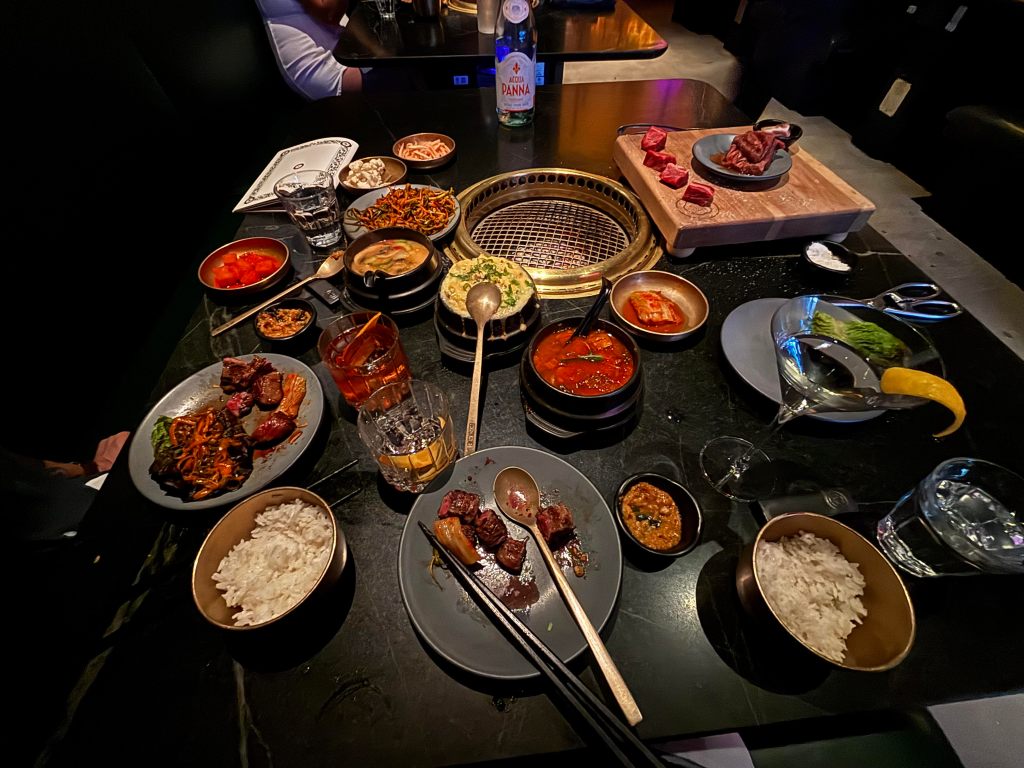
When my partner and I went for our four year anniversary, we decided on the Butcher’s Feast, which featured a selection of prime beef cuts that were cooked directly in front of us. This also included small plates of kimchi, soups, eggs, and house made pickles. According to an article from JPMorgan Chase, customers, especially millennials, want dining out to nourish both body and soul, and this experience delivered that. We were amazed by how fresh and clean all the food looked on the plates, despite the large quantity. It truly tasted like we were eating something good for us.
What made the experience worthwhile, though, was the couple sitting at the table next to us. From what we gathered by eavesdropping, they were celebrating an anniversary, visiting from Atlanta, and trying a high-end restaurant for the first time. We witnessed their first Michelin experience and watched as each plate of food was delivered to them. Every item on the Butcher’s Feast tasting menu is also available as a shareable appetizer or side dish on the regular menu, large enough to be split with a group. Although the experience and spectacle of our waiter preparing each cut of meat with his speciality scissors was fun, and the couple next to us was left in slack-jawed awe, the pretentious or audacious air often found in small plate dining experiences was noticeably absent.
We got a chance to speak to nearly every waiter, our sommelier, and yes, even the couple next to us. Though it was our most expensive dinner to date, we didn’t leave with a feeling of being duped as we have with other ‘high class’ dining experiences (don’t even get me started on Limoncello on Washington Ave). Everyone we got a chance at a conversation with voluntarily told us how much they loved working there or how much they enjoyed their experience. Yes, there was a giant neon sign that hovered above the bar and rotated like a garish pink moon, and the din of a hundred people chattering about how expensive and grandiose the menu was nearly deafening, and my vesper martini was over twenty dollars, but the equal attention to detail offered to the experience along with the food served to establish an a more colloquial environment that erred on the side of comfortable rather than alienating.
Style Over Substance
“It’s a big place. Bigger and more multifaceted than it’s given credit for. We tend, over the years, to focus on Miami’s, how shall I put this? … Party zone.” – Anthony Bourdain
So, what distinguishes a good experience from a bad one in the Miami culinary scene? Phuc Yea, an Asian fusion restaurant on Biscayne Boulevard in the Little River neighborhood, offers similar promises to those made by Cote. Although it lacks a Michelin star, the restaurant has earned the Bib Gourmand award from the Michelin guide, which is comparable to Cote in terms of award-winning food and value. Phuc Yea is an interesting case study due to its specialty cocktails and haute cuisine with an Asian-inspired flair.
My partner and I have actually been to Phuc Yea twice. Our first visit served as an introduction to what the Miami culinary scene had to offer, since neither of us had ever been to a restaurant with a twenty two dollar cocktail or a small plates concept. Our waiter suggested ordering a variety of shareable appetizers and sides, along with one or two entree portions, to round out the meal. We were able to order as we went, finding new dishes that jumped out to us and being able to gauge our fullness appropriately.
Somewhere in the two years between our first and secondary visit, however, aspects of this experience evolved. As our waiter launched into his familiar explanation of their small-plate dining concept, something caught my attention: we had to order all the food we wanted at once. I’d heard of other restaurants doing this, but experiencing it in person felt much more abrupt and disarming. He also informed us there was a 90 minute hold on the table. He stood by our table side as we picked through the menu and ordered about five dishes, none of which were memorable enough for me to describe in detail now. We hadn’t ordered any drinks, and we also skipped dessert, as we would have decided on it before eating our meal, and we weren’t sure how full we would be.
Most importantly, we didn’t linger.
The food wasn’t the issue, in fact, it was quite good, but when entertainment takes priority over comfort or ease of experience, what else is there to say? Nearly every other occupied table was hosting a celebration of some kind, such as a birthday party, a bachelorette party, or a night out for newcomers to Miami, and the atmosphere was electric, with thundering house music, dimmed lighting, and flashes of neon. This restaurant, which prioritizes locally sourced produce and boasts a Bib Gourmand award, seems to contradict its claim of good quality and value with the actual product it serves. This isn’t to say that experiences prioritizing style over substance don’t have a place in Miami’s culinary culture; you can stroll through Mary Brickell Village, throw an empanada, and hit a beloved restaurant that thrives on this very reason, but this seems at odds with the original ethos of small-plate eating.
The Rhetoric Behind Haute Cuisine
The Covid-19 pandemic has led to a significant increase in the variety of Miami’s culinary landscape, as millions of people from places like New York City and California have moved there in search of affordable real estate and an ideal setting for their remote work. This focus on entertainment value along with high quality food and ingredients is not new, as there have always been food trends. It’s when common, previously overlooked ingredients become trendy and dining culture follows suit that we see the true divide between experience and politics.
Experiential dining has evolved beyond a prime rib dinner at the nicest steak house in town, becoming a thrilling hunt for the next Michelin star hopeful, whether hidden behind a taco stand or in the heart of Miami’s most expensive neighborhoods.
Small plate dining is inspired by tapas, a Spanish accompaniment to drinking that varies from meats and cheeses to more elaborate offerings. Imagine elevated beer nuts, like those at your local dive, but made with manchego and jamón instead of peanuts, and minus the sticky beer fingers. As Anthony Bourdain discovers during a trip to Granada for his show, No Reservation, tapas are free. This is one of the key differences between tapas and small plate dining. It’s unusual in our culinary culture to offer high-quality food for free, but these small plates of carefully curated ingredients are priced similarly to full entrées at some locations, even if they don’t always offer an entrée option.
Not every dining experience can match the boldness of Papi Steak, but that doesn’t stop restaurants from marketing themselves as pioneers of designer food and haute cuisine, drawing in customers who crave new experiences and want to showcase their luxurious lifestyle. The influx of money from transplants into the Miami economy, whose dollar goes further than it would in states with income tax, is part of the reason behind this sudden boom in bold, expensive, and often small concept dining.
The success of these restaurants is no accident either. According to Connie Ogle of the Miami Herald, “This year, 2024, marks the third year of a three-year deal between Michelin and state tourism and marketing agency Visit Florida, as well as tourism agencies in Miami, which paid the guide an estimated $1.5 million to rate and highlight restaurants from 2022-2024.”
You Get What You Pay For
During his conversation with Zach Zamboni, Anthony Bourdain laughs at the idea that a major metropolitan center like New York could possibly adopt the trend of free tapas as long as you continue drinking. “Three dollars for a glass of wine and the food is free? I want a golden unicorn that shits money,” he says emphatically, and almost a decade later, this author still shares a similar sentiment about the Miami food scene.
Although small plates and designer cocktails have become a staple in the current trendy dining scene, it is no more free than it was when Anthony Bourdain was alive. A balancing act has emerged, where the spectacle of eating out is increasingly overshadowing quality, and the rare opportunity to truly get what you pay for has become a novelty.
Our experiences at Cote and Phuc Yea illustrate this: both award-winning restaurants, prized for their food and the value of experience, but only one delivered the sense of camaraderie and community they both advertised.
The concept of tapas, or small plates, is about exploration, lingering with friends to enjoy a drink and a selection of small dishes. Small plates can be weaponized against the average consumer; for instance, what was a once-in-a-lifetime experience for the couple next to us was just a special dinner for my partner and me, but we all ate, drank, and enjoyed each other’s company together.
Extravagant food, though a status symbol that signals to others that you can attain something they cannot, ultimately alienates and dismisses one of the things that makes Miami worthy of nuanced exploration. Most of these restaurants stimulate local economies and provide unique experiences that should not be understated.
This is illustrated best through Ogle quoting chef Evan Burgess in her article for the Miami Herald, “So many farmers have been gracious to us and supported our business, we want to support them,” he said. “The only way to ensure the good guys stay there in Homestead is to support them…”
Works Cited
“Why Detroit and Miami Are the next Big Foodie Hotspots.” JPMorgan Chase & Co., J.P. Morgan, 31 Jan. 2023, http://www.jpmorganchase.com/newsroom/stories/detroit-miami-foodie.
Koch, Amy Tara. “In Miami, a Pandemic-Fueled Boom.” International New York Times, 21 July 2022. Gale Academic OneFile, link.gale.com/apps/doc/A710888539/AONE?u=miam11506&sid=googleScholar&xid=56707e1a.
“Three Miami Restaurants Just Earned Michelin Stars – but One Local Spot Got Bumped.” Phuc Yea, 18 July 2024, http://www.phucyea.com/news-item/miami-herald-three-miami-restaurants-just-earned-michelin-stars-but-one-local-spot-got-bumped/.
Doss, Laine. “Anthony Bourdain Parts Unknown: You Don’t Know Tapas.” Miami New Times, 23 Sept. 2013, http://www.miaminewtimes.com/restaurants/anthony-bourdain-parts-unknown-you-dont-know-tapas-6572284.
Bourdain, Anthony, et al. World Travel: An Irreverent Guide. Ecco, an Imprint of HarperCollins Publishers, 2021.
 Emmie Writes
Leave a comment